
What Marketing Automation Actually Is (and Why Most Teams Set It Up Wrong)
Marketing automation gets misunderstood more than almost any other business technology. Ask ten marketers what it means and you'll get ten different answers — email scheduling, CRM workflows, AI copywriting, lead scoring. They're all partially right, but none of them capture the full picture.
Here's the clearest definition: marketing automation is the use of software and triggers to automatically handle repetitive marketing tasks while personalizing customer experiences at scale. That last part — at scale — is what separates real automation from just scheduling a few emails ahead of time.
The numbers back up how seriously businesses are treating this. Approximately 76% of enterprises already use some form of marketing automation technology, and the sector is projected to reach $13.71 billion by 2030. Businesses not investing in automation right now are falling behind on response time, personalization, and cost efficiency — all at once.
The mistake most teams make when setting this up: they buy a platform, load in a contact list, and start blasting emails. That's not automation — that's just email marketing with extra steps. Real automation is built around behavior. When a visitor hits your pricing page three times in a week, something should happen. When a lead downloads an eBook but never books a call, a workflow should activate. When a customer hasn't purchased in 90 days, a re-engagement sequence should fire automatically.
This guide walks through exactly how to set that up — from auditing your funnel to choosing the right tools to building workflows that actually convert.
Step 1: Map Your Customer Journey and Identify Trigger Points
Before you touch any software, you need a map. Marketing automation is only as smart as the logic you feed it, and that logic comes from understanding how your customers actually move through your funnel.
The Trigger-Based Mindset
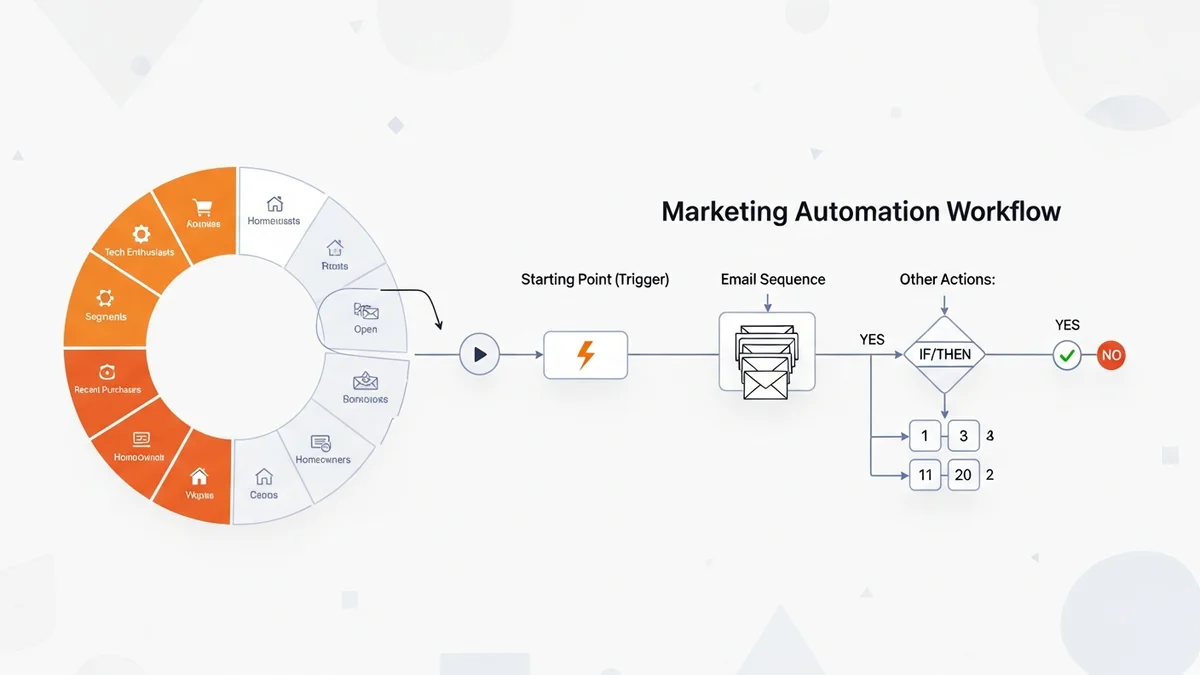
Everything in marketing automation starts with a trigger — a customer action (or inaction) that initiates a response. The most effective triggers include:
- Form submission (newsletter signup, lead magnet download, contact form)
- Page visit behavior (pricing page, product page, repeated visits in a short window)
- Email interaction (opened but didn't click, clicked but didn't convert)
- Purchase or abandonment events (checkout started, cart abandoned mid-session)
- Time-based triggers (30 days since last purchase, subscription renewal approaching)
The goal at this stage isn't to build workflows yet — it's to list every meaningful moment in your customer journey where the right message at the right time would change behavior. That list becomes the skeleton of your automation architecture.
Segment Before You Automate
Automation without segmentation is just noise at scale. Before building any workflow, define your core audience segments. A SaaS company might segment by trial users, paying customers, and churned accounts. An ecommerce brand might segment by purchase frequency, product category, or acquisition source.
The more precise your segmentation, the more relevant your automated messages become. The shift in 2026 is away from hyper-personalization — trying to predict every individual preference — toward relevance: making sure every message is contextually appropriate for where the person is in their journey right now.
Step 2: Choose the Right Platform Stack
This is where most guides just list every tool on the market and call it a day. Instead, think about this as layers — because no single platform does everything well, and trying to make one tool handle your entire automation stack usually results in a fragile, expensive mess.
The Four Layers of a Modern Marketing Automation Stack
| Layer | Purpose | Example Tools |
|---|---|---|
| Data & CRM | Central contact database, lead management, activity tracking | HubSpot, Salesforce, Freshsales |
| Campaign Execution | Email, SMS, and multi-channel campaign delivery | ActiveCampaign, Klaviyo, HubSpot Marketing Hub |
| Integration Middleware | Connecting tools, syncing data, automating cross-app workflows | Make, Zapier, n8n |
| Analytics & Reporting | Campaign performance, attribution, revenue reporting | HubSpot, Salesforce, dedicated BI tools |
The integration middleware layer is the one most businesses consistently underestimate. Tools like Make and Zapier are the connective tissue that makes the rest of the stack function as a unified system. Without them, your CRM data doesn't flow into your email platform, your ad audiences don't update when leads convert, and your sales team doesn't get notified when a high-value prospect takes a buying signal action.
Picking Your Core Platform: What to Actually Evaluate
For most small to mid-sized businesses, the decision comes down to a CRM with built-in automation versus a standalone automation platform. HubSpot and Salesforce dominate the enterprise space, but they come with significant cost and implementation complexity. For teams that want CRM power without the overhead, platforms like Freshsales offer solid automation sequences and contact management at a more accessible price point.
The key features to evaluate in any platform:
Newsletter
Get the latest SaaS reviews in your inbox
By subscribing, you agree to receive email updates. Unsubscribe any time. Privacy policy.
- Visual workflow builder — Can you map logic visually without writing code?
- Lead scoring — Can the system automatically rank leads based on behavior? (Visiting a pricing page should be worth more points than opening a newsletter.)
- Multi-channel support — Email only, or does it handle SMS, ads, and web personalization too?
- CRM integration depth — Does it sync bidirectionally with your sales team's tools in real time?
- Reporting granularity — Can you attribute revenue to specific automation sequences, not just campaigns?
Step 3: Build Your First Three Workflows
Don't try to automate everything at once. The teams that get the most out of marketing automation start with three high-impact workflows, get them performing well, then expand. Here's where to focus first.
Workflow 1: The Welcome Sequence
Every new subscriber or lead should enter a welcome sequence immediately after opting in. This isn't just a "thanks for signing up" email — it's a structured series that establishes your value proposition, sets expectations, and moves the contact toward a first meaningful action: booking a call, starting a trial, or making a purchase.
A solid welcome sequence runs 3–5 emails over 7–10 days. Each email should serve a distinct purpose: introduce the brand, deliver the promised value, share social proof, address a common objection, and close with a clear next step. The goal is momentum — each email should make the next one feel natural to open.
Workflow 2: The Lead Nurturing Drip Campaign
Not every lead is ready to buy immediately. Drip campaigns are automated sequences designed to nurture leads over time — maintaining contact, building trust, and gradually moving prospects toward a purchase decision without requiring manual follow-up from your sales team.
The best drip campaigns are behavior-adaptive. If a lead clicks a link about a specific product feature, the next email in the sequence should go deeper on that feature — not continue down the generic path. This is where lead scoring becomes essential: assign points to actions (visiting the pricing page scores +20 points, clicking an email CTA scores +10 points) and use those scores to trigger different branches of your workflow. Leads that hit a threshold score get routed to sales; leads that don't keep receiving nurture content.
Workflow 3: The Re-Engagement Flow
For ecommerce businesses, the abandoned cart sequence is often the single highest-ROI automation in the stack. Someone added items to their cart and left — they've already shown strong purchase intent. An automated sequence starting within an hour of abandonment, with follow-ups at 24 and 72 hours, consistently recovers meaningful revenue from contacts who would otherwise be permanently lost.
For B2B or SaaS businesses, the equivalent is a cold-lead re-engagement flow. If a contact hasn't interacted with any emails in 60 days, trigger a re-engagement sequence with a different angle — a new case study, a direct question about their current challenges, or a fresh piece of content targeting a pain point you haven't addressed yet. If they don't engage after 3–4 touches, remove them from your active list to protect deliverability.
Step 4: Connect Your Stack with Integration Middleware
Here's where the real leverage of modern marketing automation lives. Individual platforms are good at their specific function, but the compounding value comes when they communicate automatically. A lead fills out a form on your website → that contact gets added to your CRM → a welcome sequence starts in your email platform → your sales team gets a Slack notification → the lead gets added to a Facebook Custom Audience for retargeting. All of that happens in seconds, without anyone touching a keyboard.
This kind of cross-platform orchestration requires integration middleware. The three dominant tools in this space are Zapier, Make, and n8n — each with distinct tradeoffs worth understanding before you commit.
Zapier is the most beginner-friendly, with the largest app library (6,000+ integrations). It's the right choice for teams that want to get connected fast without technical complexity. The tradeoff is cost: Zapier's pricing scales steeply with task volume, which becomes significant as your automation runs tens of thousands of tasks per month.
Make (formerly Integromat) offers substantially more powerful visual workflow building at a lower cost per operation. It handles complex multi-step scenarios, conditional branching, and data transformation far better than Zapier. The learning curve is steeper, but for teams running serious automation volume, Make is the more scalable choice.
n8n is the open-source option — self-hostable, highly customizable, and free at the core. For technical teams that want full control over their automation infrastructure without per-task pricing, n8n has become a serious contender in 2026, particularly for businesses with developer resources who want to avoid vendor lock-in.
Critical Integrations to Build First
- CRM ↔ Email Platform: Contact data, tags, and lifecycle stages should sync bidirectionally in real time
- Website Forms ↔ CRM: Every form submission should create or update a CRM contact automatically, with source attribution preserved
- CRM ↔ Sales Notifications: High-intent actions (pricing page visits, demo requests, lead score thresholds) should trigger real-time sales alerts
- Email Platform ↔ Ad Platforms: Converted buyers should be automatically suppressed from retargeting audiences to stop wasting ad spend
Step 5: Measure Performance and Build an Optimization Loop
Setting up automation is the beginning, not the end. The teams that consistently improve results over time treat their automation as a living system — regularly auditing performance, testing variations, and expanding what works. Set it and forget it is how you end up with outdated sequences quietly doing damage to your deliverability and brand.
The Metrics That Actually Matter
There's a tendency to over-report vanity metrics like open rates and click rates. Those numbers are useful for diagnosing issues within a specific email, but they don't tell you whether your automation is driving revenue. The metrics that matter at the system level:
- Lead-to-customer conversion rate by source — Which acquisition channels produce leads that actually convert through your sequences?
- Time-to-conversion — How long does it take a lead to become a customer through your automated workflows?
- Revenue attributed to automation — What percentage of total revenue can be tied back to specific workflows?
- Workflow completion rate — What percentage of contacts who enter a sequence complete it without unsubscribing or going inactive?
The Testing Cadence
Build a regular testing cadence into your automation management. Each month, pick one high-traffic workflow and run an A/B test on a single variable — subject line, send time, email copy angle, or CTA placement. Document what you learn and apply it across similar workflows. Over six months, this iterative approach compounds into meaningful conversion improvements that would be impossible to achieve with one-time optimizations.
Also conduct a quarterly automation health review: suppress contacts who've been unresponsive for 180+ days (they hurt deliverability and inflate your list costs), archive workflows that are no longer relevant, and update sequences to reflect any product, pricing, or positioning changes. Stale automation is worse than no automation — it signals to email providers that your list is low-quality and trains contacts to ignore you.
What's Changing in 2026: Trends That Should Shape Your Setup Decisions Today
Marketing automation in 2026 looks meaningfully different from even two years ago. Understanding where the technology is heading helps you build a stack that won't need to be rebuilt in 12 months.
AI Is Moving from Assistant to Orchestrator
If 2025 was the year marketers experimented with AI, 2026 is the year it becomes a full marketing copilot — one that can analyze campaign data, suggest workflow optimizations, and in some cases autonomously adjust send times, subject lines, and audience segmentation based on real-time performance signals. This isn't science fiction: platforms are already shipping autonomous AI features that modify campaigns without manual intervention. The implication for your setup is that choosing platforms with strong AI roadmaps today will compound into significant capability advantages over the next 12–18 months.
Privacy and First-Party Data Are Reshaping Personalization
Stricter privacy regulations are forcing a fundamental rethink of how behavioral data gets used. First-party data — information your contacts have explicitly shared with you — is becoming the primary fuel for personalization as third-party data becomes less reliable and more legally fraught. This makes your email list and CRM database more valuable than any paid channel, and it's a strong argument for investing heavily in lead capture automation that collects rich data with clear consent from day one.
Unified Data Is the New Competitive Moat
Fragmented data — where your email platform doesn't know what your CRM knows, and your ad platform can't see either — produces fragmented customer experiences. A lead who just converted shouldn't keep receiving top-of-funnel ads. A customer who complained to support shouldn't get an upsell email the same day. The brands winning in 2026 are those with a unified data layer: one source of truth that every marketing tool draws from and writes back to. This is exactly what integration middleware like Make and Zapier enables, and it's why that layer of the stack deserves as much strategic attention as the platforms sitting on top of it.
Marketing automation done right is one of the highest-leverage investments a business can make. It scales your team's capacity without scaling headcount, delivers more relevant experiences than any manual campaign could, and creates a compounding advantage over competitors who are still managing campaigns by hand. The setup work is front-loaded — but once your core workflows are running, your stack is connected, and your optimization loop is in place, the system works for you around the clock whether your team is at their desks or not.