
What Are AI Agents and Why They Matter for Business in 2026
AI agents are autonomous software entities designed to perform tasks, make decisions, and solve problems with minimal human intervention. Unlike a simple chatbot that waits for your next command, an AI agent sets its own sub-tasks, monitors results, and adapts its approach until a goal is achieved. That distinction matters enormously when you are trying to run a business at scale.
The market is responding accordingly. The global AI agents market is projected to reach $47.1 billion by 2030, growing at a compound annual rate of 44.8%. This is not a niche experiment — it is a fundamental shift in how businesses operate. Companies that treat AI agents as a side project today will be playing catch-up within 18 months.
The Four Characteristics That Make AI Agents Different
Most automation tools execute instructions. AI agents do something more interesting — they reason. The four properties that separate an AI agent from a basic script or workflow are:
- Autonomy: Agents operate independently, executing multi-step tasks without constant human oversight or hand-holding.
- Adaptability: They learn from experience and adjust behavior when environments or inputs change.
- Interactivity: Agents communicate with users and other systems, enabling coordination across departments and tools.
- Goal-orientation: Rather than following rigid if-then logic, they focus on achieving an objective and choose the path to get there.
These properties mean that when you deploy an AI agent to handle customer escalations, it does not just route tickets — it reads context, decides whether a refund or an apology is more appropriate, drafts the response, and logs the outcome for future learning.
Where AI Agents Deliver the Most Business Value
The research is clear: AI agents are not a single-department play. They are already reshaping operations across HR, finance, customer service, sales, marketing, and logistics. Here is where businesses are seeing the most measurable impact right now.
Human Resources: Eliminating the Resume Pile
AI agents are automating 75% of resume screening tasks, freeing HR teams from the most time-consuming part of hiring. Instead of a recruiter spending a full day parsing 200 applications, an agent ranks candidates against structured criteria, flags edge cases for human review, and schedules initial calls — all before the recruiter's morning coffee. The downstream effect is faster hiring cycles and better candidate experience, not just cost savings.
Healthcare and Compliance: High-Stakes Automation
Ninety percent of hospitals are expected to adopt AI agents by 2026 to improve predictive analytics and patient outcomes. In compliance-heavy industries more broadly, AI agents are enhancing accuracy and reducing manual workloads across audit preparation, regulatory reporting, and risk flagging. The pattern is the same: repetitive, rule-bound tasks that carry real consequences are exactly where agents outperform human processes at scale.
Sales and Go-to-Market: AI as Your Pipeline Engine
This is the application most business owners underestimate. AI agents can research a prospect's website, surface relevant talking points, draft a personalized outreach sequence, and update your CRM — all triggered by a single new contact entering your pipeline. When paired with a capable CRM like Close, agents can prioritize follow-up queues based on deal signals rather than date-of-entry. That is not automation in the traditional sense; that is a sales assistant that never sleeps.
Marketing: Content, Discovery, and Distribution
Buyers in 2026 are not just Googling — they are asking AI assistants for recommendations. That means your discoverability now depends on whether large language models can find, understand, and trust your business. AI agents can audit your content structure, identify gaps in your messaging, and even draft the LLM-readable infrastructure (like an llm.txt page or structured case studies) that makes you recommendable. Ignoring this is the 2026 equivalent of ignoring mobile optimization in 2014.
AI Agents vs. Traditional Workflow Automation: A Practical Comparison
Many businesses already use workflow automation tools, and the question is how AI agents fit alongside or on top of that existing stack. The answer is not either-or — it is layered. Here is how the two approaches compare across the dimensions that matter for business buyers:
Newsletter
Get the latest SaaS reviews in your inbox
By subscribing, you agree to receive email updates. Unsubscribe any time. Privacy policy.
| Dimension | Traditional Workflow Automation | AI Agent-Powered Automation |
|---|---|---|
| Decision logic | Pre-defined if/then rules | Contextual reasoning toward a goal |
| Setup requirement | Explicit mapping of every step | Define the objective; agent plans steps |
| Handles edge cases | Fails or routes to human by default | Adapts and attempts resolution first |
| Best use case | Predictable, repeating tasks (invoices, notifications) | Complex, variable tasks (research, triage, drafting) |
| Learning over time | No — static until manually updated | Yes — improves from interaction history |
| Multi-system coordination | Limited — point-to-point integrations | Native — agents operate across tools simultaneously |
| Market adoption (2026) | Mature — widely deployed | Fast-growing — $47.1B projected market by 2030 |
The practical takeaway: you do not retire your existing automation. Tools like Zapier or Make remain excellent for deterministic workflows — moving data between apps, triggering notifications, syncing records. AI agents sit on top of that foundation and handle the judgment calls those platforms cannot make.
How to Implement AI Agents in Your Business: A Step-by-Step Approach
The businesses that fail at AI agent implementation share a common mistake: they start with the technology instead of the problem. Here is the approach that actually works.
Step 1: Identify High-Volume, High-Judgment Tasks
Look for work that is happening dozens of times per week, involves some degree of decision-making, and currently requires a capable human to complete. Resume screening, customer complaint triage, lead qualification, and contract review are classic candidates. Tasks that are purely mechanical (moving a file, sending a scheduled email) are better served by traditional automation.
Step 2: Audit What AI Already Knows About You
Open an AI tool in incognito mode and ask: "I'm looking for [your product/service]. What companies should I consider?" Then ask: "Tell me about [your company]." If the answers are missing, inaccurate, or vague, you have a content and structure problem that will undermine every AI-assisted sales and marketing effort you make. Fix your AI-readable infrastructure before you scale outbound.
Practically, this means creating structured, plain-language content about who you are, who you serve, and what outcomes you deliver. Standardized case studies using a consistent problem-solution-result format are particularly effective because they give AI systems clear, quotable evidence of your value.
Step 3: Choose the Right Automation Layer
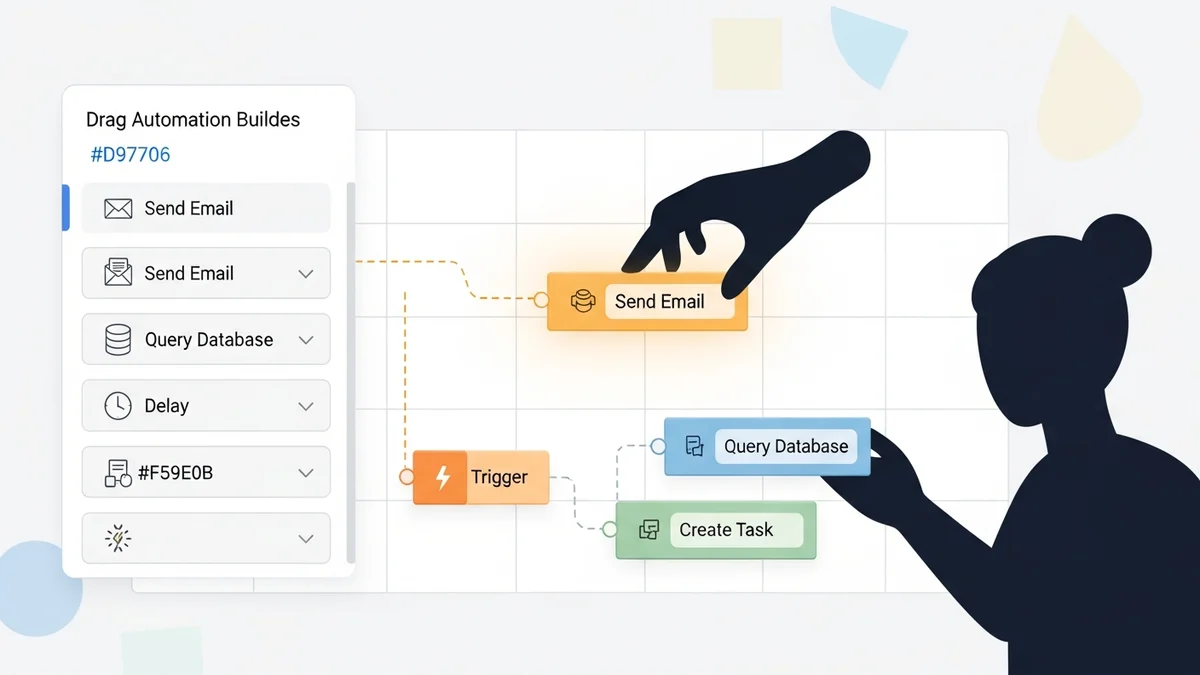
Your AI agent needs connectors to the tools it will interact with. For businesses that already run on Microsoft's stack, Microsoft Power Automate offers deep native integration with Office 365, Teams, and Dynamics. For teams that want maximum flexibility and are comfortable with a more technical setup, n8n is an open-source option that lets you self-host agent workflows with full control over data residency. For leaner teams that want pre-built connectors without the overhead, Activepieces offers a modern no-code interface with an expanding library of integrations.
The choice depends less on feature lists and more on where your team's technical confidence sits. A tool your team will not maintain is worse than a simpler tool they will actually use.
Step 4: Start With a Multi-Agent Pilot, Not a Big Bang
AI agents can be deployed in multi-agent systems — meaning multiple agents work together, autonomously or collaboratively, across different departments. But starting there is a recipe for complexity. Instead, deploy a single agent against one high-value workflow, measure the results over 30 days, and use those learnings to calibrate your next deployment. Businesses that try to automate everything at once almost always end up with a fragile, hard-to-debug system that gets quietly shut down three months later.
Step 5: Use AI as a Planning Partner, Not Just an Executor
One of the highest-leverage uses of AI agents that most businesses overlook is strategic planning support. Before your next quarterly planning cycle, use an AI assistant to pressure-test your goals. Share your current metrics, last year's performance, and the objectives you missed — and ask it to identify the tradeoffs and risks in your proposed plan. AI does not regress to the mean if you give it real constraints and real data. The output from this kind of dialogue frequently surfaces blind spots that a room full of people with the same context would miss.
Common Mistakes That Derail AI Agent Projects
After watching dozens of businesses attempt AI agent deployments, the failure modes are predictable enough to be preventable.
Treating AI Agents as a Cost-Cutting Tool First
The businesses that get the most from AI agents frame the goal as capability expansion, not headcount reduction. When you ask "how do I eliminate roles?" you optimize for cost and underinvest in outcomes. When you ask "how do I let my best people do more of what only humans can do?" you end up with both better results and better morale. HR professionals freed from screening 200 resumes can spend that time on candidate experience and culture fit — work that compounds.
Skipping the Data Foundation
An AI agent is only as good as the data it operates on. If your CRM records are incomplete, your customer data is siloed, or your documents live in 14 different formats, your agent will produce mediocre output regardless of how capable the underlying model is. Before deploying agents, invest one sprint in data hygiene. It is unglamorous work that makes everything downstream better.
No Human Review Loop in High-Stakes Workflows
The modular nature of AI agents enables businesses to scale and customize deployment — but in compliance, finance, and customer-facing workflows, human review checkpoints are not optional. Build approval gates into any workflow where a mistake has legal, financial, or reputational consequences. Autonomy is a spectrum, and where you set the dial should reflect the cost of a wrong answer, not just the efficiency gain from removing oversight.
Building an AI-Ready Business: The Operational Mindset Shift
The businesses that will compound their advantage over the next three years are not the ones buying the most AI tools — they are the ones building operational habits that make AI work better over time. That means maintaining clean, structured data. It means documenting processes explicitly enough that an agent can follow them. It means reviewing AI outputs with genuine critical attention rather than rubber-stamping whatever the model produces.
It also means staying visible to AI systems in the ways buyers now use to discover vendors. If a prospect asks an AI assistant for a recommendation in your category and you are not in the answer, you have already lost a deal you never knew was in play. The infrastructure investments that feel optional today — structured content, clear positioning, consistent case study formatting — are becoming table stakes for staying in the conversation.
AI agents in 2026 are not a competitive differentiator for the businesses that deploy them. They are a competitive disadvantage for the ones that do not.