
Why Manual Sales Pipeline Management Is Costing You Revenue
Sales reps lose hours every week to tasks that have no business being manual: updating deal stages, drafting the same follow-up email for the fourth time this week, moving contacts between tools, chasing down information that should have been logged automatically. As pipeline volume grows, these friction points compound. The team that closes 50 deals a month on a manual workflow doesn't close 500 deals a month by working harder — they hit a wall.
The 2026 sales landscape has made one thing clear: automation isn't a competitive advantage anymore, it's a baseline expectation. Companies using AI-assisted pipeline tools are outpacing those that aren't, not because they hired better salespeople, but because they removed the administrative overhead that was slowing their reps down. This guide covers the stages worth automating, the tools that actually deliver, and how to build a stack that holds up as your pipeline scales.
The Five Pipeline Stages Where Automation Has the Highest ROI
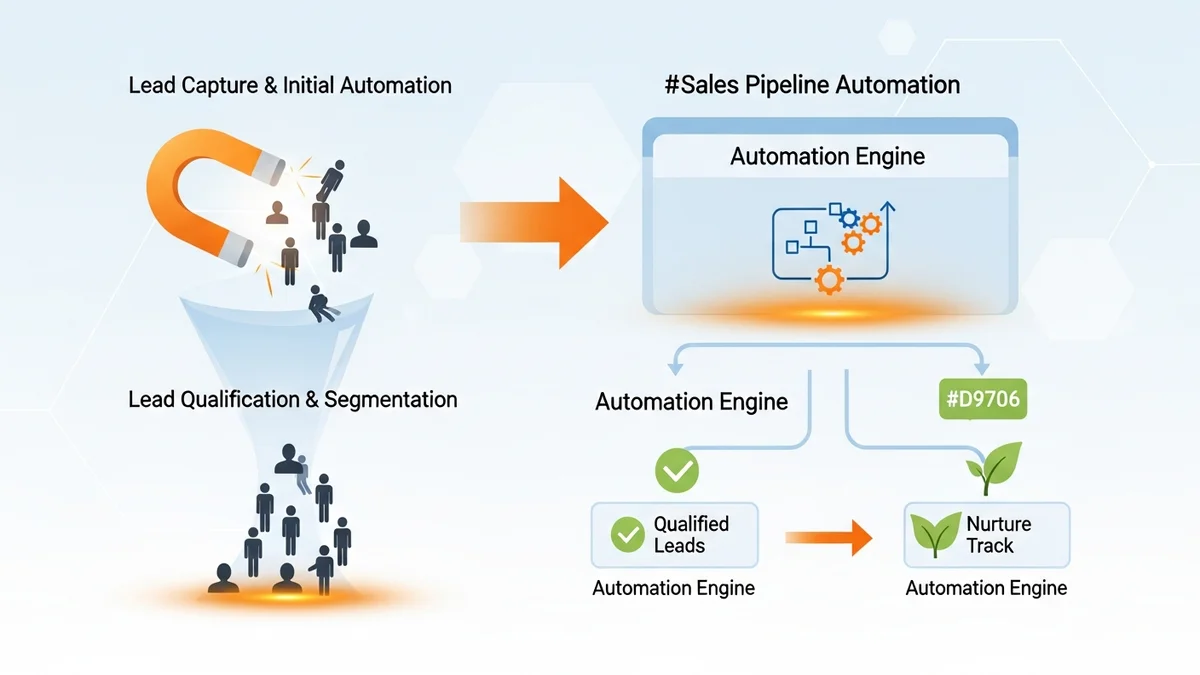
Not every part of a sales motion should be automated. Late-stage negotiation, executive relationships, and complex deal structuring still require human judgment. But the connective tissue between stages — the data gathering, the routing, the follow-ups — is precisely where automation compounds fastest.
Lead Capture and Enrichment
Every inbound lead triggers the same research loop: company size, funding status, tech stack, decision-maker hierarchy, recent news. Doing this manually per lead is pure waste. Automated enrichment tools pull this data from multiple sources the moment a lead enters the pipeline, so reps start their first call with context instead of spending 20 minutes on LinkedIn beforehand. Clay, highlighted in Glenn Poulos's 2026 AI sales stack, is built specifically for this — pulling enrichment data at scale to make outreach land with relevance rather than guesswork.
Lead Scoring and Routing
Not all leads deserve equal attention, and misrouting a high-intent enterprise prospect to a rep with a full plate is an expensive mistake. Automated scoring based on firmographic and behavioral signals — pages visited, forms submitted, email engagement — ensures your highest-value leads reach the right rep at the right time. This is where tools like Substrata add a layer that traditional CRMs can't: AI that reads tone and intent signals to help you understand where you actually stand in a deal.
Outreach Sequencing
Personalized outreach at scale is one of the clearest wins in pipeline automation. Sequences triggered by specific behaviors — a pricing page visit, a demo request, a content download — consistently outperform generic cadences. The goal isn't to remove the human voice from outreach; it's to ensure that the right message goes out at exactly the right moment without someone manually hitting send. Regie.ai and AiSDR both operate in this space, with AiSDR handling outbound volume so reps can stay focused on real conversations rather than prospecting tasks.
Meeting Scheduling
Every extra step between expressed interest and a booked meeting is a conversion leak. Automated scheduling removes the back-and-forth entirely — a prospect clicks a link, sees real availability, and books in under 60 seconds. As Poulos's 2026 stack notes, the best tools in this category "turn interest into booked meetings fast." That should be the standard your pipeline holds, not the exception.
Pipeline Tracking and Forecasting
Deal stages that update automatically, forecast rolls that reflect actual momentum, risk flags that surface before deals go cold — this is where automation shifts from efficiency to strategy. Gong delivers call insight and deal coaching with fewer surprises. Clari tracks momentum and risk across the funnel, giving revenue leaders the visibility to make real decisions rather than gut calls. Salesforce Sales Cloud's advanced forecasting and AI add-ons serve the same purpose for enterprise teams that need governance and scale baked into the platform.
The Right Tool Stack for Sales Pipeline Automation
The market for sales automation tools has exploded, but most teams are better served by a focused stack than by collecting every promising product. Here's how to think about the categories and which tools belong in each layer.
CRM as the Automation Foundation
Your CRM is where pipeline data lives and where most automation logic will originate. The right CRM for your team depends on complexity, team size, and how much customization you actually need versus how much you think you need.
Salesforce Sales Cloud is the enterprise standard. Its AppExchange marketplace connects to thousands of tools, and its native forecasting and AI capabilities — particularly at the Unlimited tier — are genuinely powerful. The trade-off is cost and complexity: the Starter Suite begins at $25/user/month, but enterprise-grade features sit in the Unlimited tier at $330/user/month, plus implementation costs that can dwarf the license fees. For organizations managing complex sales cycles with large teams and extensive data requirements, that investment is justified. For most SMBs, it's overkill.
HubSpot Sales Hub offers a more accessible path for small to mid-market teams. Contact management, deal tracking, email sequences, and meeting scheduling are centralized without requiring dedicated IT support. It earns its place in Poulos's recommended stack as a "CRM built for an AI-first workflow" with "smooth automations and strong integration support." For teams that want to be running in weeks rather than months, HubSpot is the more realistic starting point.
For high-velocity sales teams where pipeline speed is the primary lever, Close is purpose-built for that motion — less CRM overhead, more focused on calling, emailing, and moving deals forward fast. Similarly, Freshsales offers solid built-in automation with a lighter footprint than Salesforce, which makes it a practical option for growing teams that don't need enterprise complexity.
Newsletter
Get the latest SaaS reviews in your inbox
By subscribing, you agree to receive email updates. Unsubscribe any time. Privacy policy.
Workflow Automation: The Connective Tissue
If your CRM is the brain of your pipeline, your workflow automation platform is the nervous system. This layer handles the logic between tools — when this happens in the CRM, do that in Slack, then update this spreadsheet, then send this email. Getting this layer right is what separates a pipeline that runs itself from one that requires constant manual intervention.
N8N has become a standout for technical sales teams in 2026. Poulos's AI sales stack describes it as "clean, no-code automation" that "links your entire stack from trigger to close." Its self-hosted option keeps costs predictable at scale, and its flexibility means you're not constrained by what a SaaS vendor decided workflows should look like. If your team has the technical capability to run it, n8n offers more power per dollar than most alternatives.
Make (formerly Integromat) is the visual builder option for teams that want power without writing code. Its scenario builder makes complex multi-step workflows readable and debuggable — which matters when an automation breaks before a pipeline review. Make's integration with platforms like Lovable also makes it a natural fit for teams building custom sales applications layered on top of standard tools.
Zapier remains the most accessible entry point for teams new to workflow automation. It covers the common cases — CRM field updates, email triggers, Slack notifications, deal stage changes — without requiring any technical expertise. Its breadth of integrations is still the widest available, which matters when your stack includes niche tools that newer platforms haven't prioritized yet.
For teams that need enterprise orchestration with compliance controls baked in, Workato and Microsoft Power Automate both offer the governance layer that larger organizations require, particularly when automation touches regulated data or cross-departmental systems.
Pipeline Automation Tool Comparison
| Tool | Category | Entry Price | Best Fit | Standout Capability |
|---|---|---|---|---|
| Salesforce Sales Cloud | CRM | $25/user/month (Starter Suite) | Enterprise, large mid-market | AppExchange ecosystem, advanced forecasting, AI add-ons |
| HubSpot Sales Hub | CRM | Free tier; paid plans scale with team | SMB to mid-market | Integrated sequences, meeting scheduling, zero IT setup |
| n8n | Workflow Automation | Free (self-hosted) | Technical teams needing full flexibility | Full-stack automation, no vendor lock-in |
| Make | Workflow Automation | Free tier available | Teams building visual multi-step workflows | Visual scenario builder, readable automation logic |
| Zapier | Workflow Automation | Free tier available | Teams new to automation | Widest integration library, fastest setup |
| Clari | AI Sales Intelligence | Enterprise pricing (direct quote) | Revenue teams prioritizing forecast accuracy | Deal momentum tracking, pipeline risk signals |
| Gong | AI Sales Intelligence | Enterprise pricing (direct quote) | Teams focused on call quality and deal coaching | Call insight, pipeline truth, fewer surprises |
How to Build Your Automation Stack Without Overcomplicating It
The most common mistake in sales pipeline automation is doing too much too fast. Teams buy five new tools in a quarter, spend six weeks on implementation, and end up with a fragile stack of automations that nobody fully understands and everyone blames when a deal slips through.
A more effective approach is to start with the highest-friction point in your current pipeline — the task that eats the most rep time or causes the most dropped follow-ups — and automate that one thing completely before moving to the next. In most teams, that's either lead enrichment or outreach sequencing. Both are well-served by the tools above and don't require overhauling your entire tech stack to implement.
Evaluate Integration Depth Before You Buy
The single most underrated decision in sales tool selection is integration capability. A great CRM that doesn't talk to your marketing automation platform, your meeting tool, and your Slack workspace creates data silos that manual work has to bridge — defeating the purpose. Before committing to any platform, map out the exact data flows your pipeline requires and verify that the integration exists, is native, and handles the specific fields you need. A pre-built connector that only syncs contact names is worse than no connector, because it creates false confidence.
Build for Visibility, Not Just Speed
Automation that moves leads through the pipeline faster is valuable. Automation that also gives you accurate data on where leads are, why they stalled, and which sources are converting is transformative. From the outset, instrument your automation workflows to log the data you'll need for forecasting and coaching. Clari and Gong both operate on this principle — they're not just automating tasks, they're surfacing intelligence that helps the whole team improve.
The Bottom Line on Sales Pipeline Automation
Sales pipeline automation in 2026 isn't a single product decision — it's an architectural decision. The teams winning are those that have thought carefully about which layer each tool belongs to: the CRM as the system of record, the workflow platform as the integration layer, and AI-native tools as the intelligence layer on top.
For most teams, the practical starting point is a CRM with solid native automation (HubSpot for SMBs, Salesforce for enterprise), combined with a workflow automation platform that connects your broader stack. N8N or Make handle this layer well for teams that need flexibility, while Zapier is the fastest path to results for teams without technical resources. Layer in AI tools selectively — for enrichment, call intelligence, or forecasting — where you have specific gaps rather than trying to automate everything at once.
The pipeline that scales isn't the one with the most tools. It's the one where the tools you've chosen actually work together, give your reps more time in real conversations, and give leadership the visibility to make better decisions. That's the standard worth building toward.