
The Automation Landscape Has Shifted — And Most Businesses Haven't Caught Up
For the past decade, "automation" meant one thing: rule-based scripts that executed the same steps, in the same order, every time. That was enough. Payroll ran itself. Invoices got processed. Tickets got routed. It worked because the data was clean, the processes were stable, and the rules didn't change often.
That era is ending — not because traditional automation was wrong, but because the problems businesses need to solve have outgrown it. According to a mid-2025 PwC survey, 79% of companies already have AI agents implemented in some form, and of those, 66% report measurable value in productivity, cost savings, decision speed, and customer experience. A separate Cloudera survey of more than 1,400 enterprise IT leaders across 14 countries found that 96% plan to expand their use of AI agents over the next 12 months.
That's not hype — that's a structural shift. This post breaks down what separates AI agents from traditional automation, where each approach wins, and how to think about the decision for your business.
What Traditional Automation Actually Is (And What It Was Never Built to Handle)
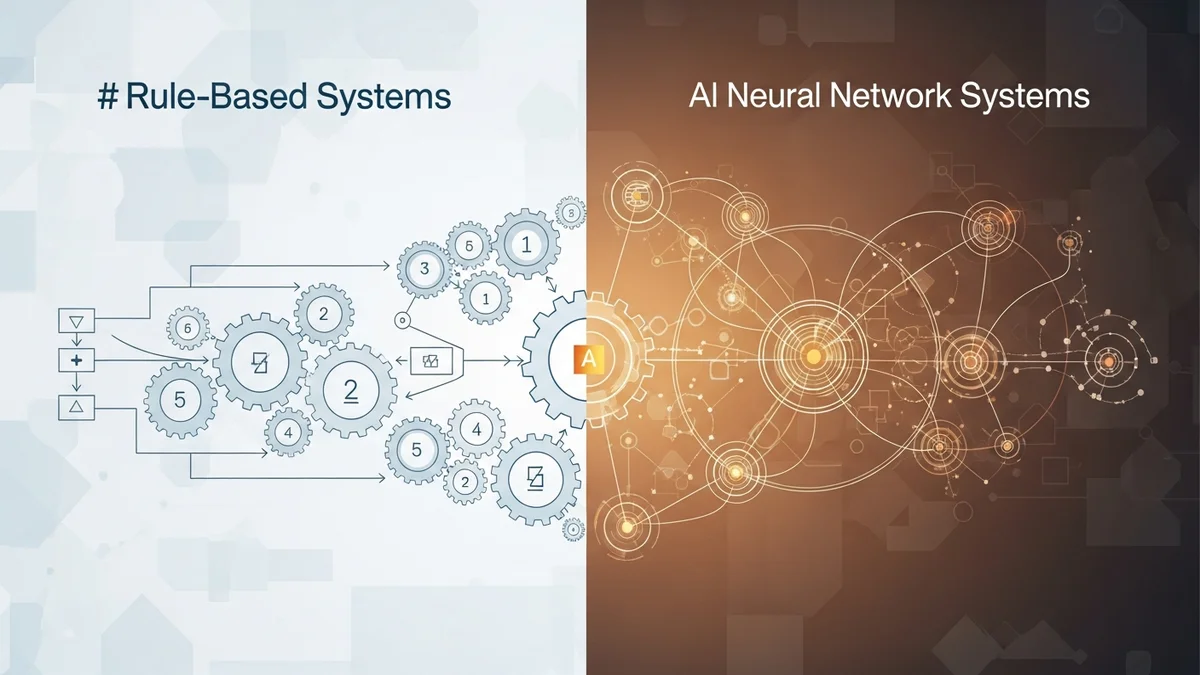
Traditional automation — including RPA (robotic process automation), rule-based workflows, and scripted bots — operates like a digital assembly line. You define the inputs, specify every step, and the system executes it at scale without deviation. It's deterministic by design.
Where It Excels
When the task is repetitive, the data is structured, and the rules don't change, traditional automation is genuinely excellent. Tools like Zapier and Make have made this accessible to teams without engineering resources — connecting apps, triggering sequences, moving data between systems, all without writing code. For straightforward workflow automation across SaaS tools, these platforms remain among the most efficient options available.
The business case for RPA at scale is also well-documented. Deloitte's global research found that 53% of businesses already use RPA, and organizations that apply it to high-volume, routine functions typically see 20–30% reductions in operational costs. Those are real numbers on real workflows — payroll, invoice processing, IT ticket routing, data entry.
Where It Breaks Down
The problem is that "high-volume, routine functions" represents a shrinking share of the actual work businesses need to automate. The harder problems — processing emails, interpreting PDFs with variable formats, handling customer exceptions, adapting to changing business logic — are where rule-based systems hit a wall.
The failure rate tells the story: up to 50% of RPA projects fail to deliver their expected ROI, often because they were applied to processes that require judgment, not just rule-following. You can't write a rule for "handle this complaint appropriately" or "decide whether this invoice is legitimate." Every exception becomes a manual intervention, which erodes the efficiency gains the automation was supposed to create.
Maintenance is the other hidden cost. Every time a source system changes its UI, updates its field names, or adds a step to a process, someone has to rewrite the script. At scale, that's a significant ongoing burden that most RPA cost projections undercount.
What AI Agents Actually Do Differently
AI agents are not just "smarter bots." The architectural difference matters: instead of executing a fixed sequence of steps, an AI agent reasons about a goal, plans a sequence of actions, executes them, observes the results, and adjusts. It can work with unstructured data — emails, voice notes, scanned documents, images — because it doesn't need the input to be pre-formatted.
Key Capabilities That Change the Equation
Handling exceptions autonomously: Where a traditional bot would halt and escalate, an AI agent can interpret context, apply judgment, and continue. A customer complaint with an unusual return scenario doesn't require human escalation if the agent can reason about policy and precedent.
Working with unstructured data: Natural language, PDFs with inconsistent layouts, voice transcripts — AI agents can extract meaning from inputs that rule-based systems can't parse without extensive pre-processing pipelines.
Newsletter
Get the latest SaaS reviews in your inbox
By subscribing, you agree to receive email updates. Unsubscribe any time. Privacy policy.
Proactive rather than reactive behavior: Traditional automation responds to a trigger. AI agents can monitor conditions, anticipate needs, and initiate actions without waiting for a human to start the sequence.
Adaptive to changing conditions: When a business process evolves, an AI agent doesn't necessarily need to be reprogrammed from scratch. Its behavior can adapt based on updated context or instructions in natural language.
The adoption curve reflects this value. By end of 2025, approximately 85% of enterprises were expected to have implemented AI agents in some form, with 23% already scaling them across business functions according to MarketsandMarkets research.
Head-to-Head Comparison: AI Agents vs Traditional Automation
| Dimension | Traditional Automation | AI Agents |
|---|---|---|
| Data types handled | Structured (forms, databases, spreadsheets) | Structured and unstructured (text, voice, images, PDFs) |
| Exception handling | Halts and escalates to humans | Reasons through exceptions autonomously |
| Adaptability | Requires manual script updates when processes change | Adapts to new conditions via reasoning and context |
| Setup complexity | Lower upfront — rule definition is straightforward | Higher upfront — requires LLM integration, prompt design, tool configuration |
| Maintenance burden | High — UI changes and process updates break scripts | Lower — goal-directed agents tolerate surface-level changes |
| Cost reduction potential (when well-applied) | 20–30% operational cost reduction (Deloitte) | Early adopters report productivity and decision-speed gains; ROI data still maturing |
| RPA adoption rate | 53% of businesses (Deloitte) | 79% of enterprises have some AI agent implementation (PwC, 2025) |
| Failure rate | Up to 50% of RPA projects miss expected ROI | 66% of AI agent deployments delivering measurable value (PwC, 2025) |
| Best for | High-volume, structured, stable processes | Complex, judgment-heavy, variable, or unstructured workflows |
Which Approach Does Your Business Actually Need?
The honest answer is: probably both, used for the right jobs.
Traditional automation is still the right tool for any workflow where the inputs are predictable and the rules are stable. If you're processing thousands of invoices with consistent formats, syncing CRM data between systems, or triggering email sequences based on behavioral events, Microsoft Power Automate and similar RPA platforms will outperform AI agents on cost and reliability. There's no reason to pay for reasoning when determinism is what you need.
The calculus shifts when you hit complexity. If your workflow involves:
- Interpreting customer intent from free-form messages
- Processing documents that don't follow a fixed schema
- Making decisions that depend on context, not just rules
- Handling high exception rates that are burning human hours
- Adapting to business logic that changes frequently
...then rule-based automation will fail you. Not occasionally — systematically. The 50% RPA failure rate isn't a vendor quality problem; it's a category mismatch problem. Businesses apply RPA to processes that require judgment, and rule-following systems cannot provide judgment.
A Practical Framework for the Decision
Ask three questions about any process you want to automate. First: is the input always structured and predictable? If no, traditional automation will require extensive pre-processing or will fail on exceptions. Second: does the process ever require a judgment call that can't be reduced to a rule? If yes, you need an agent or a human. Third: how often do the rules change? Processes that evolve frequently are expensive to maintain in traditional automation and are better served by goal-directed agents that adapt to updated instructions.
The Tools That Sit at the Intersection
What's interesting about the current moment is that the line between traditional automation platforms and AI-capable systems is actively blurring. Workflow automation tools are adding native AI steps, and AI agent frameworks are adding structured workflow capabilities. The categories are converging.
n8n is a good example of a platform that straddles both worlds — its open-source, self-hostable architecture lets teams build traditional rule-based workflows alongside AI-powered nodes that can call LLMs, parse unstructured inputs, or make decisions mid-flow. For technical teams that want control without vendor lock-in, it's increasingly attractive as AI steps become table stakes in automation tooling.
Workato sits at the enterprise end of the same convergence — an integration and automation platform that has added AI capabilities for enterprises that need governance, role-based access, and audit trails alongside intelligent automation. If your organization already runs enterprise-grade RPA and is looking to layer AI judgment on top without rebuilding from scratch, Workato's model is worth examining.
For teams starting fresh with lighter-weight requirements, Activepieces offers an open-source foundation that's adding AI-native capabilities — worth considering if cost control and customizability matter more than out-of-the-box enterprise features.
The point is that you don't have to pick a camp and fully commit. The practical path for most businesses in 2026 is a layered approach: traditional automation handling the high-volume, structured backbone, with AI agents sitting at the edges where data gets messy or decisions require context.
Our Take: Stop Asking "Which Is Better" — Start Asking Where Each Belongs
The framing of "AI agents vs. traditional automation" is a useful starting point, but the real question for any operations leader is about fit, not superiority. Traditional automation is not obsolete — it's doing exactly what it was built to do, and the 53% of businesses running RPA aren't wrong to be running it. The mistake is expecting rule-following systems to handle judgment-requiring tasks, which is what drives the 50% failure rate.
AI agents represent a genuine capability expansion, not just an upgrade. The PwC data showing 66% of deployments delivering measurable value — across productivity, cost savings, and customer experience — is encouraging, but it also means 34% are not yet delivering. The implementation quality gap is real, and rushing to replace working automation infrastructure with AI agents because they're newer is how you end up in that 34%.
The businesses winning with automation in 2026 are the ones mapping their workflows honestly: identifying which processes are genuinely deterministic and running efficient traditional automation there, while deploying AI agents precisely where human-like reasoning was the missing ingredient. That disciplined approach — not wholesale replacement in either direction — is what separates measurable value from expensive experimentation.